British colonial rule over India and Pakistan led to many South Asians settling in British territories in East Africa, including Kenya, Tanzania, and Uganda. In the 1970s, these African nations gained independence, freeing themselves from British colonial rule. These new nations, however, were not welcoming toward the South Asian settlers, and sought to free themselves from the social and economic hierarchies the British had constructed. As a result, many of these South Asians migrated again, this time settling in the United Kingdom, where they had British citizenship as they were born in territories under colonial rule.
These migrants did not find themselves welcomed in the United Kingdom either. They had left behind white-collar office jobs and comfortable lifestyles, but in the UK, the only jobs available were factory jobs, often with low wages and harsh working conditions. The Grunwick film factory, a focal point for this movement, employed primarily female South Asian workers. These women endured harsh control from their managers. They were expected to work overtime, had to ask permission to use the restroom, and were constantly expected to meet high production demands. If they didn’t meet these demands, or slipped up in any way, they were at risk of being fired.
In 1976, one of the workers at the Grunwick factory, Jayaben Desai, led a strike in protest of the harsh treatment by their managers. Over the next couple of days, 200 more workers walked out and they joined a trade union. The workers continued to strike for months, while the union garnered support on a national level, publishing pamphlets highlighting the racist character of the Grunwick factory leadership. These pamphlets included quotes like, “I can buy a Patel for 15 pounds” and others that disrespected South Asian culture.
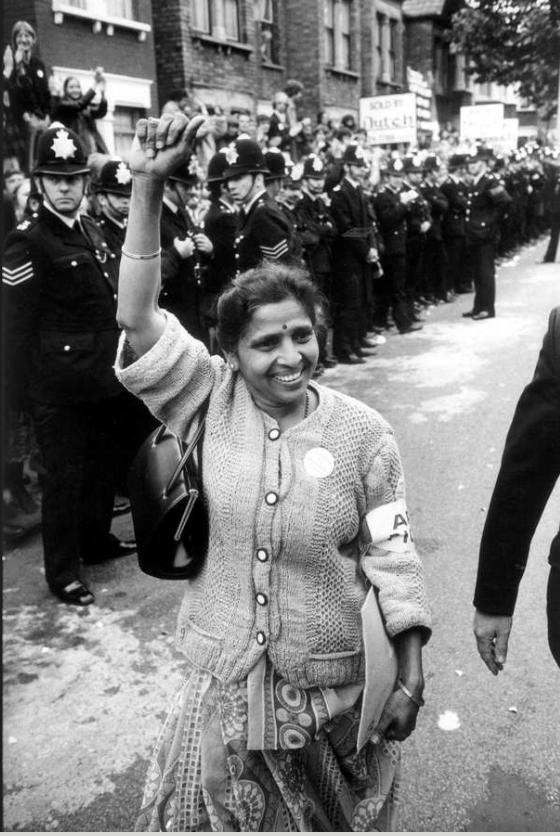
Jayaben Desai leading a strike in 1977
Though the strikers’ movement gained attention across the country—with the Union of Post Office Workers even instructing its members not to process Grunwick’s mail—the factory refused to engage or negotiate. Eventually, the unions supporting the strikers wished to withdraw their support, and in a final Hail Mary act, Mrs. Desai led a hunger strike outside the Trade Union Congress headquarters. Even this was unsuccessful, and so the strike ended unresolved. Even though Desai and the other strikers were out of a job, their efforts brought positive change for the workers who remained at Grunwick, including the company providing workers with transport to work and pensions.
More importantly, the strikers challenged stereotypes that South Asians, particularly women, were submissive and could be easily exploited in the workforce. By forging alliances with trade unions and receiving national attention, Desai’s movement encouraged intersectional alliances, as thousands of workers, across races and genders, worked together to fight for the rights of female immigrant workers. In recognition of her work, Jayaben Desai was awarded with a gold medal from the GMB trade union in 2007.
 History Unfiltered
Leave a comment